
The $800,000 HIPAA Settlement That Was Mostly About Routine Work
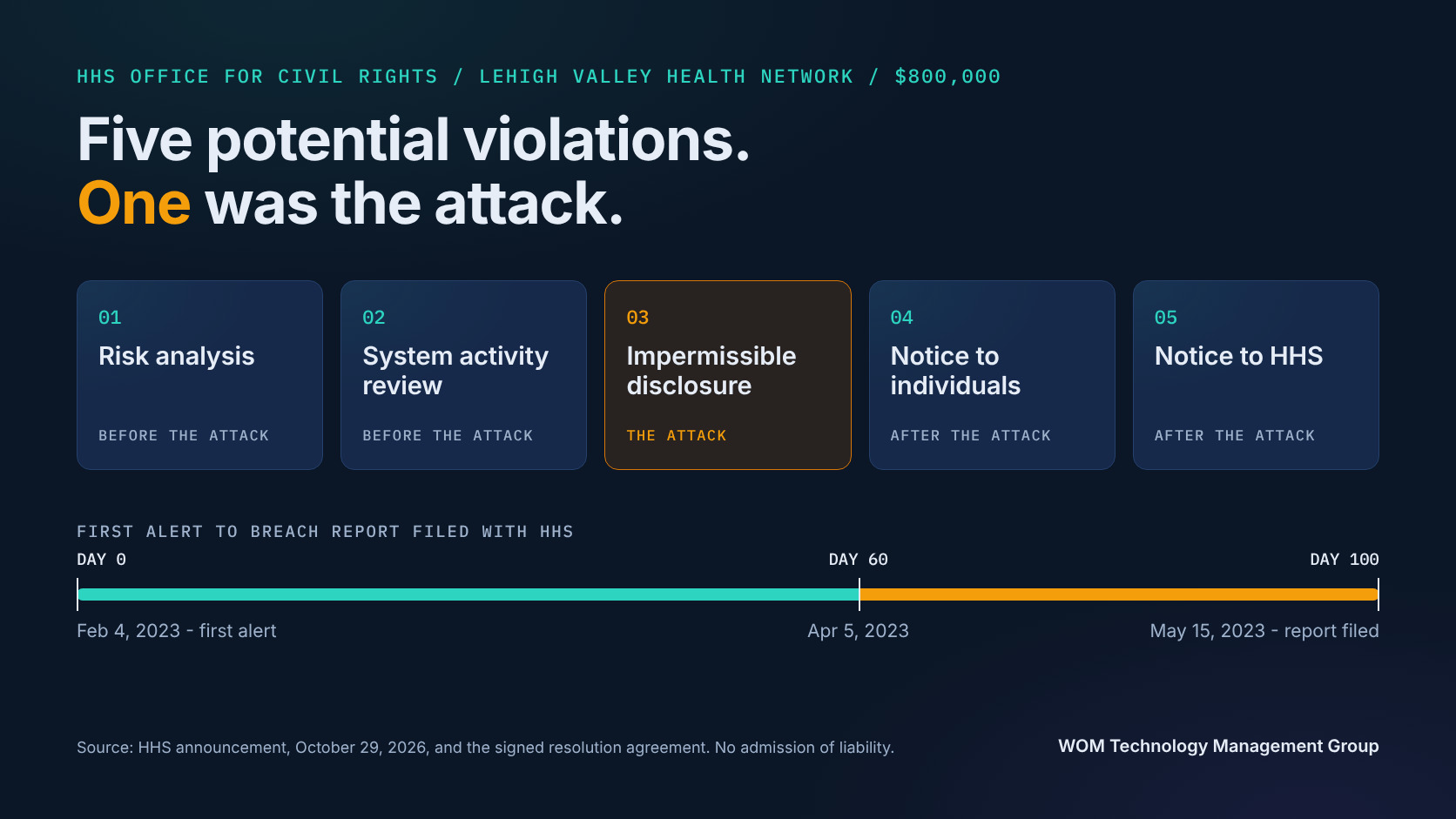
A HIPAA ransomware settlement isn't only about the ransomware. In the Lehigh Valley Health Network case, four of the five findings describe routine work that was not done before the attack, or deadlines that were missed after it.
A HIPAA resolution agreement is a settlement between the HHS Office for Civil Rights (OCR) and a HIPAA-regulated organization that closes an investigation in exchange for a payment and a monitored corrective action plan.
On October 29, 2026, OCR announced that Lehigh Valley Health Network (LVHN), a Pennsylvania health system, paid $800,000 and agreed to three years of monitoring. OCR counts it as its 22nd ransomware enforcement action.
One point before the details. The signed agreement states that it is not an admission of liability by LVHN. OCR describes its findings as potential violations, and so do I.
What happened at Lehigh Valley Health Network?
The agreement and the announcement give this sequence.
- 2021: LVHN acquired the practice now called Lehigh Valley Physician Group - Delta Medix.
- February 2023: LVHN's malware detection tools flagged suspicious activity in the Delta Medix IT system. OCR's announcement dates the discovery to February 4, 2023.
- After the alert: LVHN's investigation found ransomware. Protected health information (PHI) had been copied out and posted on the dark web.
- March 2023: LVHN began notifying affected individuals.
- May 15, 2023: LVHN filed its breach report with HHS.
- October 2026: LVHN signed the agreement on October 8, OCR signed on October 9, and OCR announced it on October 29.
The breach affected 248,359 people. According to OCR, the exposed data included names, addresses, dates of birth, Social Security numbers, driver's license numbers, financial information, diagnoses, lab results, medications, treatment information, and sensitive photographs of radiation oncology patients.
What did OCR say went wrong?
The agreement lists five items. Each one cites a specific section of the HIPAA rules.
- No accurate and thorough risk analysis: The Security Rule requires an assessment of the risks to all electronic PHI an organization holds (45 CFR 164.308(a)(1)(ii)(A)).
- No regular review of system activity: The Security Rule requires procedures to regularly review records such as audit logs, access reports, and security incident tracking reports (45 CFR 164.308(a)(1)(ii)(D)).
- Impermissible disclosure of PHI: The records of 248,359 people were disclosed through the ransomware attack (45 CFR 164.502(a)).
- Late notice to individuals: The Breach Notification Rule sets a deadline for telling affected people (45 CFR 164.404(b)).
- Late notice to HHS: The same rule sets a deadline for telling the HHS Secretary (45 CFR 164.408(b)).
Only item 3 is the breach itself.
Items 1 and 2 are work the Security Rule requires before any incident. Items 4 and 5 are deadlines that start after one.
None of those four needs an attacker. An organization can have all four gaps on an ordinary Tuesday.
How late was the notification?
OCR does not publish its calculation. The dates it does publish allow some simple arithmetic.
HHS's summary of the Breach Notification Rule says notice goes out "without unreasonable delay and in no case later than 60 days." For breaches affecting 500 or more people, that outer limit applies to the notice to HHS as well as the notice to individuals.
Sixty days from February 4, 2023 is April 5, 2023. LVHN filed its report with HHS on May 15, 2023. That is 100 days after the first alert.
Two cautions on that math. The 60-day clock runs from discovery of the breach, which can be later than the first alert. And the agreement says individual notices began in March 2023, yet still lists individual notice as untimely. The public documents do not say which notices were late or by how much.
The lesson holds either way. The clock is short, and it starts while the investigation is still under way.
Why does the acquired practice matter?
The first alert came from the IT system of a physician practice LVHN had acquired two years earlier.
The corrective action plan reflects that. Before the new risk analysis, LVHN is required to complete an inventory of its systems. The plan covers 15 listed LVHN entities and locations, from hospitals to home care and hospice.
HHS's risk analysis guidance is direct about scope. The analysis covers all electronic PHI an organization creates, receives, maintains, or transmits, wherever it resides.
A system you inherited is still your system. So is the old server from the practice you bought, the laptop a retired provider left behind, and the billing software nobody has logged in to for a year.
What does LVHN have to do now?
The corrective action plan runs three years. Its deadlines are specific.
- Inventory: Complete a system inventory before the risk analysis.
- Scope and method: Send OCR the proposed scope and methodology for the risk analysis within 30 days of the agreement's effective date.
- Risk analysis: Deliver the completed analysis within 120 days of OCR approving the scope.
- Risk management plan: Deliver a plan to address what the analysis found within 60 days of OCR approving the analysis.
- Policies and procedures: Review and revise them, distribute them to the workforce within 30 days of OCR approving the risk management plan, and review them at least annually.
- Training: Train all workforce members within 60 days of that approval, then every 12 months. Nobody gets access to electronic PHI until they have certified their training.
- Reporting: Report workforce non-compliance to OCR within 60 days, file annual reports, and keep the records for six years.
If LVHN fails to meet the plan and does not cure it, the agreement allows HHS to pursue civil money penalties for the original conduct.
Every item on that list is something the HIPAA rules already asked for. The settlement adds a regulator checking the work.
What does OCR recommend for everyone else?
OCR closed its announcement with steps for covered entities and business associates. In plain English:
- Map the data: Know where electronic PHI lives and how it enters, moves through, and leaves your systems.
- Keep the risk analysis current: Conduct it regularly, update it, and maintain a risk management plan.
- Record system activity: Keep audit controls in place.
- Read what you record: Review system activity on a regular schedule.
- Verify users: Use authentication so that only authorized people reach electronic PHI.
- Encrypt: Protect electronic PHI in transit and at rest where appropriate.
- Learn from incidents: Feed what went wrong back into the security program.
- Train for the job: Give each workforce member regular HIPAA training that fits what they do.
OCR Director Paula M. Stannard put the agency's position in one line: "The best defense against cyberattacks is full implementation of the HIPAA Security Rule."
How WOM helps
The five findings map to work we do for customers every week.
- Risk analysis and risk management plan: Governance, Risk & Compliance covers the HIPAA risk analysis, the plan that follows it, and the policies and training behind both. See the HIPAA page for what the rule covers.
- An independent check: A Third-Party Assessment reviews your HIPAA program against what your policies say, by an assessor with no role in your daily IT.
- Someone reading the logs: Cyber Risk Management covers 24/7 threat monitoring, anomaly detection, and configuration hardening.
- When the clock is already running: Digital Forensics & Incident Response finds how they got in and what they reached, which is what a breach notice has to be built on. If it is happening now, go to /under-attack or call +1 (888) 966-7228.
Not sure where you stand? The Security Self-Check takes a few minutes, and the Incident First Hour tool walks through the first steps after an incident.
What this means for a business your size
LVHN is a hospital system. The two Security Rule requirements at the center of this settlement are not hospital-sized.
The risk analysis requirement applies to covered entities and business associates. HHS's guidance says the method scales with an organization's size and complexity. It does not say small organizations skip it.
For a small practice, or a business that handles patient data for one, the settlement comes down to three questions.
- Can you produce your risk analysis? A written one, covering every system that holds patient data, including anything inherited or forgotten.
- Who reviews the logs, and how often? If the answer is a product name and not a person and a schedule, that is finding number 2.
- Do you know your notification deadlines today? The 60 days start during the worst week your business has had. Decide who writes the notice and who files with HHS before you need to.
Florida has its own breach notification requirements on top of HIPAA. The Florida section of our DFIR page covers who must be told and when.
Start with the first question. Ask whoever manages your compliance to send you the current risk analysis.
If nobody can find it, that is your first gap.
Sources
- U.S. Department of Health and Human Services - HHS' Office for Civil Rights Settles Ransomware Investigation of Lehigh Valley Health Network (October 29, 2026)
- U.S. Department of Health and Human Services - Lehigh Valley Health Network Resolution Agreement and Corrective Action Plan (signed October 8-9, 2026)
- U.S. Department of Health and Human Services - Breach Notification Rule
- U.S. Department of Health and Human Services - Guidance on Risk Analysis
- Electronic Code of Federal Regulations - 45 CFR 164.308, Administrative safeguards
- Electronic Code of Federal Regulations - 45 CFR 164.502, Uses and disclosures of protected health information
- Electronic Code of Federal Regulations - 45 CFR 164.404, Notification to individuals
- Electronic Code of Federal Regulations - 45 CFR 164.408, Notification to the Secretary
Disclaimer. This article is provided for general information only. It is not legal, regulatory, or professional advice, and reading it does not create a client relationship with WOM Technology Management Group. Regulations, threats, and vendor products change; specific obligations depend on your industry, jurisdiction, contracts, and data. Verify anything you plan to rely on against the primary source and consult qualified counsel or a security professional before acting.
Sources are cited as of the last-reviewed date shown above. Where a linked source has moved or been withdrawn, the citation reflects what was verifiable at review time.